An Honest AG1 Review: 52 Iterations, £79 a Month, and What the Label Doesn't Tell You
AG1 spent a decade marketing their formula as 'perfected' through 52 iterations. In May 2025 they launched their most significant reformulation in 15 years. Here is what actually changed, what didn't, and why £79 a month is a marketing decision rather than a clinical one.
AG1's marketing has long leaned on the idea that the formula is the product of careful, iterative refinement. A widely-shared Facebook post in 2022 framed it as "perfected over the course of a decade, 52 iterations." More recent copy on the company's own site describes the product as having been "continuously upgraded" since 2010.
In May 2025, AG1 launched AG1 Next Gen. The company called it their "most significant innovation yet." Industry press described it as the first major reformulation of the product in about 15 years.
You can hold both stories in your head at once, but they sit awkwardly together. If the formula had been perfected 52 times, what made May 2025 the most significant innovation yet?
I have spent more time looking at the AG1 label than I would like to admit. Most people who buy it have never read past the front of the pouch. That is not a criticism. The front of the pouch is the only part designed to be read. The rest is doing a different job.
This is a careful look at what is actually in AG1, what the new version changed, and where the marketing language and the clinical evidence stop matching up.
What "Next Gen" Actually Changed
Per AG1's own announcement, here is what is different in the May 2025 reformulation:
- Total ingredient count rose from 75 to 83
- Probiotic dose rose from 7.2 billion CFU across 2 strains to 10 billion CFU across 5 strains
- Scoop size grew from 12g to 13g
- Vitamin B12 jumped from 22µg to 400µg, a sixteen-fold increase
- The taste was tweaked to be slightly sweeter
The B12 jump is the one worth pausing on. The recommended daily intake for an adult is 2.4µg. The previous AG1 dose of 22µg was already a generous multivitamin level. 400µg is a megadose. AG1 has not publicly explained the increase. ConsumerLab's review of the new formula flagged it specifically, noting that very high B12 doses have been associated in some observational data with acne, rosacea, and a possible signal for colorectal cancer in older adults.
The probiotic change is more interesting on paper. Going from two strains to five (Lactobacillus rhamnosus GG, L. acidophilus NCFM, Bifidobacterium lactis HN019, L. casei LC-11 and L. plantarum LP-115) is a meaningful upgrade. 10 billion CFU is in the right range for clinical activity. This is the part of the reformulation that is genuinely better.
Everything else is iteration without explanation. Eight more ingredients. A slightly bigger scoop. A sweeter taste. The price stayed at £79.
What the Disclosed Doses Actually Show
AG1 Next Gen deserves credit for something the original formula was rightly criticised for. The new label discloses individual ingredient amounts. There are no proprietary blends hiding what you are actually getting. That is a meaningful improvement and worth saying out loud.
The problem is what those disclosed amounts contain.
I ran the current AG1 product through De-Influenced before writing this post. The tool extracted the label, checked every dose against published clinical evidence, and returned a transparency score of 71 out of 100. That is "moderate" on our scale. Not awful. The dose disclosure scored a perfect 50 out of 50. The label clarity scored 15 out of 15.
What pulled the overall score down was specificity, which came in at 6 out of 35. The label lists ingredient names but not their forms. "Magnesium" without a salt or chelate could be glycinate (high bioavailability) or oxide (around 4 per cent absorbed). That distinction matters more than most consumers realise.
To AG1's credit, the form information is published. Dig into the ingredient detail pages on AG1's website and you will find that the magnesium is magnesium bisglycinate, a chelated form with good bioavailability and gentle tolerability. That is a reasonable choice. The question is why the form is not on the label itself, where most customers will look, rather than buried a few clicks deep on a product page. Transparency that requires a site search is partial transparency. The same applies to every other ingredient whose form is disclosed online but absent from the pouch.
Then the tool ran the per-ingredient dose check. The findings:
- 15 ingredients at clinical doses. Vitamin C at 420mg, zinc at 10mg, the B vitamins, and the five named probiotic strains at appropriate CFU counts. These are real wins for AG1 and they are not in dispute.
- Nine ingredients below clinical thresholds. The headline misses:
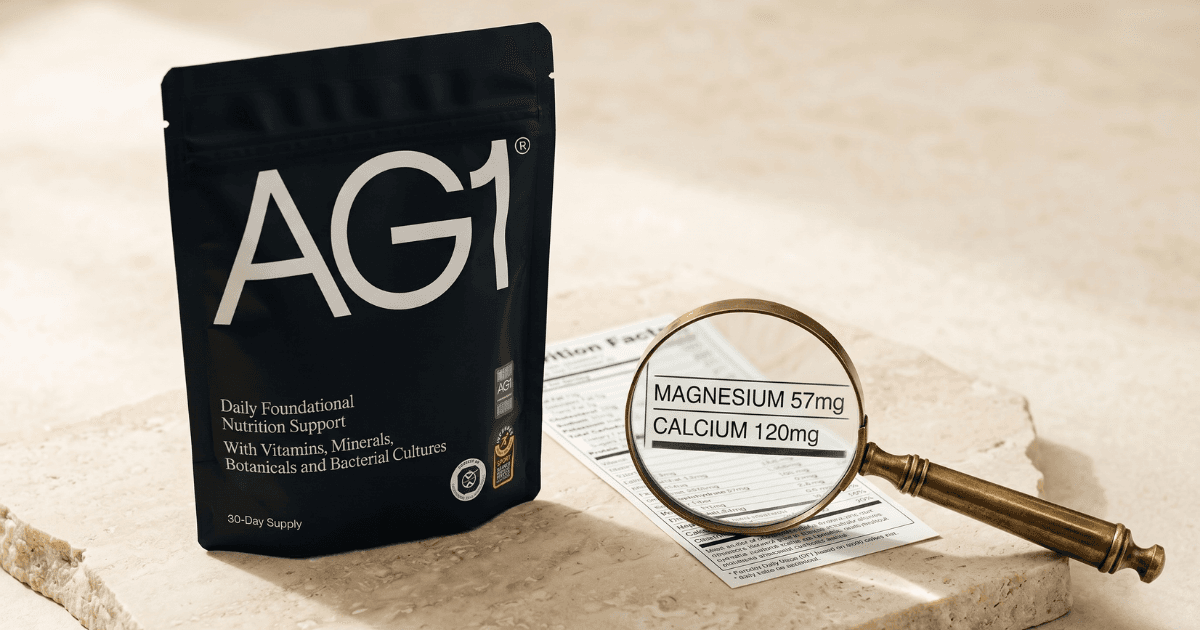
- Magnesium at 57mg. Clinical doses sit between 200mg and 400mg depending on the form and the use case. AG1 delivers between 14 and 28 per cent of what the research uses.
- Calcium at 120mg. The adult requirement is around 1,000mg per day. AG1 supplies 12 per cent.
- CoQ10 at 50mg. The clinical evidence base for CoQ10 (energy, statin-related muscle pain, mitochondrial function) uses 100mg to 200mg. AG1 sits at exactly half the lower end.
- Five ingredients that cannot be properly assessed because the form is not specified. Without a form, there is no published trial to compare against.
The dietitian Abbey Sharp made the same point in different language in her 21 February 2024 review: "Most of the functional ingredients listed on labels have clinical doses of 1 to 10 grams each, and since a scoop of powder is generally in the 10 to 15 gram range, it's highly unlikely you're getting clinically relevant doses of most of the ingredients." Maddie Pasquariello RD told the Boston Globe in April 2026 that "ingredients that they're claiming are the active ingredient in the product are often included at sub-clinical values."
AG1 has stopped hiding the doses. That is real progress. What the disclosed numbers now show is that the marketing of AG1 as a foundational nutritional product is doing more work than the formulation supports.
The Trials Are Real. The Independence Is Not.
AG1 launched Next Gen alongside four placebo-controlled human trials. They cite this as proof that the new formula works.
The trials are real. They are also small, short and entirely funded by the company that sells the product.
The largest of the four had 105 participants over 12 weeks. Two were two-week crossovers with 20 and 24 participants respectively. The fourth was an eight-hour crossover with 16 participants on acute nutrient bioavailability.
The Tinsley et al paper, published in the Journal of the International Society of Sports Nutrition in 2025, includes the following disclosure: "P.S., J.T., C.E., T.K., L.N., and R.E. disclose that they are employees of AG1. This research was funded by AG1 (Carson City, NV, USA)." Six of the authors work for the company that paid for the study.
The Gonzalez et al paper published in Frontiers in Nutrition in April 2026 is more interesting. It found that AG1 "did not produce large, global shifts in microbial alpha or beta diversity." That is the actual finding from a trial AG1 funded and that AG1 employees co-authored. Selective changes in specific bacterial strains were observed. A meaningful shift in overall gut microbiome diversity was not.
Dr JoAnn Manson, professor of medicine at Harvard Medical School and chief of the division of preventive medicine at Brigham and Women's Hospital, questioned the rigour of AG1's small trials in Fortune's January 2025 investigation by Ellie Austin: "These are very small randomized trials. Just as a comparison, we do large-scale randomized clinical trials of many dietary supplements. For a multivitamin, we did a randomized control with 15,000 participants for 11 years to document that there was, in fact, a significant reduction in cancer incidence when taking the multivitamin compared to placebo. That's what I'm talking about when I say rigor." Four small company-funded trials are not that.
Jonathan Jarry of McGill University's Office for Science and Society wrote in March 2024 that AG1 "combines the 'just in case' marketing of the multivitamin industry and unproven wellness ingredients into an expensive cocktail for the worried well." On the megadose vitamins, he was sharper: "467% of the daily recommended value of vitamin C and 1,100% of vitamin B7. You simply pee it out, which increases the financial value of your urine."
The Bryan Johnson Question
Bryan Johnson is the founder of Blueprint, a longevity protocol with its own commercial interests. I do not agree with most of how he markets his work, and I am not the audience for his content. None of which matters here.
In late 2024 and into 2025, Johnson publicly tested AG1 on himself. He ran his own blood work before and after introducing AG1 into his routine. AG1 was the only variable he changed. His report was that "nothing changed when I started taking Athletic Greens." He went further publicly: "AG1 is one of the lowest value health products in the world despite being the most heavily promoted."
AG1 responded, saying Johnson had misrepresented one of their funded studies and calling his claims "unsubstantiated."
I include this not as an endorsement of Johnson's broader work but because of what his test was. A single person, a clear protocol, a measurable outcome, and a result that did not match the marketing. The proper defence against a finding like that is a properly-powered independent trial showing the product does what it claims. Such a trial does not exist for AG1. Until it does, Johnson's blood work is, on the available public evidence, the closest thing to an independent test of AG1 that anyone has shown.
NSF Certified for Sport Means Less Than You Think
AG1 leans heavily on the NSF Certified for Sport mark. It appears on the pouch, on the website, and in podcast reads. The Amazon listing describes it as testing "at 95x the industry standard for safety."
Per NSF's own published scope, the Certified for Sport mark verifies four things:
- The label accurately reflects what is in the product.
- The product is free of more than 280 banned substances on the WADA, NFL, MLB, NHL and CFL prohibited lists.
- Manufacture occurs in a GMP-audited facility.
- Contaminants sit below NSF's internal thresholds.
NSF state plainly that they do not test for efficacy. They do not verify that the doses on a label are clinically meaningful. They do not verify that the ingredient forms specified are bioavailable. They do not verify that the formulation is scientifically sound. And, importantly for UK and EU readers, NSF's lead limit is 10 micrograms per day. That is twenty times more permissive than California's Proposition 65 maximum allowable dose level of 0.5 micrograms.
This is why AG1 pouches sold in California carry a Proposition 65 warning for lead, despite being NSF Certified for Sport. The warning traces back to a December 2015 consent judgment in Environmental Research Center v. Athletic Greens (USA) Inc., in which the company agreed to a US$78,500 payment and the ongoing warning. The Prop 65 threshold is stricter than NSF's. Both can be true at the same time, and both are.
NSF certification is a meaningful signal of manufacturing quality and label accuracy. It is not a clinical endorsement. The marketing carefully blurs that distinction.
Why £79?
AG1 costs £79 a month for a 30-day pouch on subscription in the UK, which works out to £2.63 per serving. The one-time purchase price is £97, or £3.23 per serving.
The multivitamin category average in our UK catalogue is £0.58 per serving. AG1 is roughly 5.6 times that average.
For direct comparison against other products marketed in the same space:
- Huel Daily Greens: around £1.67 per serving on subscription
- Bloom Greens & Superfoods (US): US$1.05 per serving on subscription
- Live It Up Super Greens: US$1.33 per serving on subscription, with a 30-day money-back guarantee
- Supergreen Tonik: US$2.07 to $2.90 per serving, with full open-label dosing
AG1 is between 1.5 and 2.5 times the price of the rest of the greens-powder category, and several times the price of a standard multivitamin. The premium is not paying for clinical evidence the others lack. It is paying for the marketing apparatus, the podcast sponsorships, and the scientific advisory board. According to Fortune in January 2025, AG1 has spent more than US$27 million on podcast advertising since 2022. That is more than any other supplement brand in the world.
If the formula were demonstrably better than the cheaper alternatives, the price would be defensible. The four small company-funded trials do not demonstrate that.
The Subscription Mechanics
A few things to know before you sign up for AG1, because they apply equally if you sign up and want to leave.
The checkout defaults to subscription. The one-time option is priced roughly 25 per cent higher. The Welcome Kit (canister, scoop, shaker, samples) is bundled with the first subscription order only. The second order ships at day 30 without those extras.
A class action filed on 3 February 2026, Hoke v AG1 (USA) Inc. in the US District Court for the Central District of California, alleges that AG1's auto-renewal disclosure is not in the contrasting type size required by California law and that cancellation is "exceedingly difficult and unnecessarily confusing." The named plaintiff alleges he was accidentally enrolled in a bi-monthly subscription when he attempted to cancel. AG1's terms of service contain a mandatory individual arbitration clause and class-action waiver, which may limit the case's reach.
The Better Business Bureau profile for AG1 USA Inc. is not accredited and currently flags a failure to respond to four complaints. Trustpilot reviews skew positive overall, helped by post-purchase review prompts, but a recurring minority of complaints describe charges on cards no longer on file, duplicate accounts created after cancellation, and refund refusals while a chargeback is open.
The UK money-back guarantee is 30 days. The US version is 90 days. Shipping is non-refundable in both jurisdictions.
This is not a product you can casually try.
Four Alternatives That Beat AG1 on Both Price and Dose
When De-Influenced ran AG1 against the multivitamin category, four alternatives came back at substantially lower prices with comparable or better clinical dose coverage:
- Pure Encapsulations O.N.E. Multivitamin at £0.78 per serving. 80 per cent dose match. Save 76 per cent versus AG1.
- Thorne Basic Nutrients 2/Day at £0.98 per serving. 80 per cent dose match. Save 70 per cent.
- BioCare Adult Multivitamins & Minerals at £0.42 per serving. 80 per cent dose match. Save 87 per cent.
- Bio-Kult Brighten at £0.50 per serving (multivitamin and probiotic combined). 80 per cent dose match. Save 85 per cent.
All four sit in either the premium or mid-range quality tiers. All four disclose their doses without proprietary blends. None of them is sold through a subscription auto-renewal default.
If you want the probiotic component AG1 includes, Bio-Kult Brighten covers it within that £0.50. Or you can pair a standalone multivitamin with a dedicated probiotic at clinical strain-level doses for around £0.30 per serving. Either route comes to roughly £1 per day or less. AG1 charges £2.63 to £3.23.
That is the de-influencing exercise. Same job, lower cost, transparent label, no marketing premium.
This is what De-Influenced does. You paste a product URL, we extract the label, we check every dose against clinical evidence, and we surface alternatives that are cheaper and properly dosed. No affiliate links. No sponsored placements.
Frequently Asked Questions
Is AG1 worth £79 a month?
When De-Influenced analysed the current AG1 formula, it scored 71 out of 100 on transparency (moderate) at £3.23 per serving on a one-time purchase, against a multivitamin category average of £0.58 per serving. AG1 delivers 15 ingredients at clinical doses but underdoses nine others, including magnesium (57mg against 200 to 400mg needed), calcium (120mg) and CoQ10 (50mg). Comparable multivitamins from Pure Encapsulations, Thorne, BioCare and Bio-Kult deliver similar clinical coverage at 70 to 87 per cent lower per-serving cost.
What changed in AG1 Next Gen?
The May 2025 reformulation increased the ingredient count from 75 to 83, the probiotic dose from 7.2 billion CFU across 2 strains to 10 billion CFU across 5 strains, the scoop size from 12g to 13g, and vitamin B12 from 22µg to 400µg. The price stayed at £79 a month.
Why does AG1 carry a California Proposition 65 warning?
A 2015 consent judgment in Environmental Research Center v. Athletic Greens (USA) Inc. required AG1 to carry a lead warning on product sold in California and to pay US$78,500. The warning persists today. Lead in AG1 sits below NSF's threshold of 10µg per day but above California's stricter Prop 65 maximum allowable dose level of 0.5µg per day.
Are AG1's clinical trials independent?
No. The four trials cited for AG1 Next Gen were funded by AG1. The Tinsley et al paper in the Journal of the International Society of Sports Nutrition (2025) discloses that six of the authors are AG1 employees. The Gonzalez et al paper in Frontiers in Nutrition (April 2026) found that AG1 "did not produce large, global shifts in microbial alpha or beta diversity," despite being cited as evidence for AG1's gut health claims.
Does NSF Certified for Sport mean AG1 works?
No. The NSF Certified for Sport mark verifies that the label accurately reflects what is in the product, that the product is free of substances banned in professional sport, that manufacture is in a GMP-audited facility, and that contaminants are below NSF's thresholds. NSF state plainly that they do not test for efficacy. The mark says nothing about whether the disclosed ingredient doses in AG1 are clinically meaningful or whether the ingredient forms specified are bioavailable.
Is De-Influenced free?
Yes. You can analyse supplements for free. A subscription unlocks 50 analyses a month and unlimited alternative suggestions. There are no affiliate links and no sponsored content.
Medical disclaimer: This article is for informational purposes only and does not constitute medical advice. Always consult a qualified healthcare professional before starting, stopping or changing any supplement regimen, particularly if you take prescription medication, are pregnant, or have an existing health condition. De-Influenced is a supplement transparency tool, not a medical service.